
24/7 Support DDoS Protection 99.9% Uptime

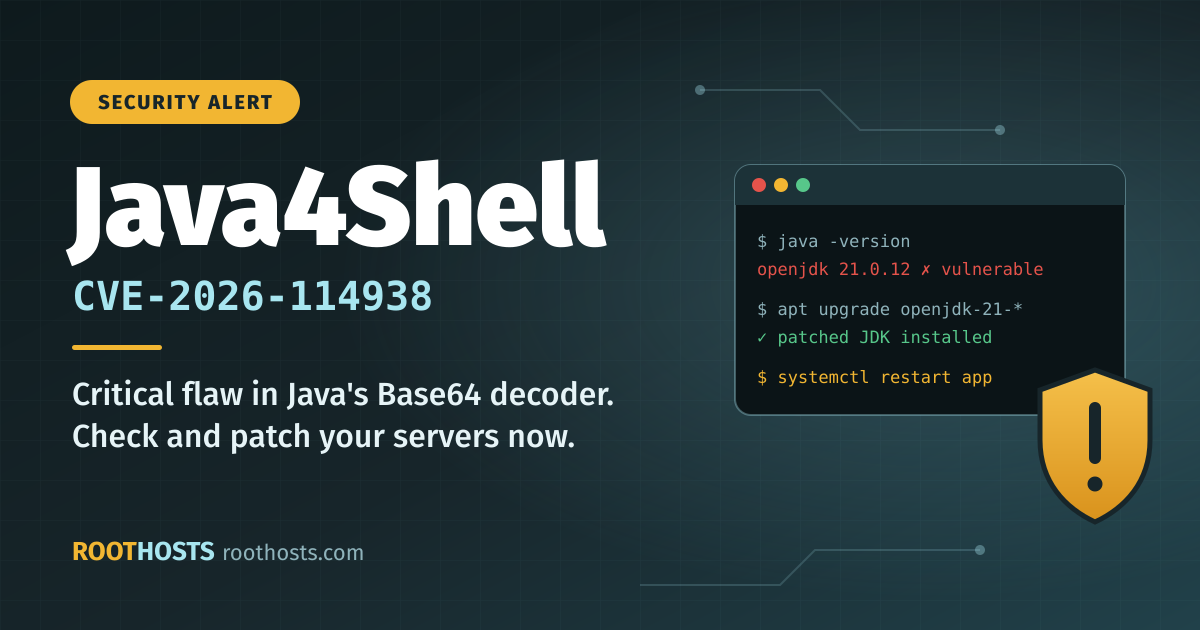
Java4Shell (CVE-2026-114938): What Server Owners Need to Do Now
On November 17, 2026, the U.S. Cybersecurity and Infrastructure Security Agency (CISA) issued an alert urging organisations to patch a newly disclosed Java vulnerability straight away. It is tracked as CVE-2026-114938 and known as Java4Shell. It affects one of the most widely used parts of the Java platform, the built-in Base64 decoder. If your business runs Java applications such as Tomcat, Spring Boot, Jetty, Elasticsearch or a vendor appliance with an embedded Java runtime, this one deserves your attention today.
What is Java4Shell?
Java4Shell is a memory-corruption bug in the HotSpot Java Virtual Machine (JVM) on x86-64 servers. To speed up Base64 decoding, HotSpot replaces the standard Java code with a hand-optimised routine that uses AVX-512 CPU instructions. When this routine receives specially crafted, malformed Base64 input, it writes data past the end of the memory buffer it was given.
In practice, this means:
- An attacker can crash the JVM remotely by sending bad Base64 data, with no login required.
- Remote code execution may be possible. The researchers who found the bug report working remote code execution in several popular Java server products in their default configurations. There is no public proof-of-concept yet.
Oracle rates the flaw CVSS 8.1 (High). The researchers rate it 9.2 (Critical). Either way, it should be patched now.
Why Base64 makes this dangerous
Base64 is everywhere in web applications. Every HTTP Basic Authentication header is Base64-encoded. So are JSON Web Tokens (JWTs), many API payloads, WebSocket messages and file uploads embedded in JSON. That means a vulnerable application can often be reached through its normal front door, sometimes before the user has even logged in. Updating Tomcat, Spring or Jetty will not fix this, because the bug is in the JDK itself.
Which systems are affected?
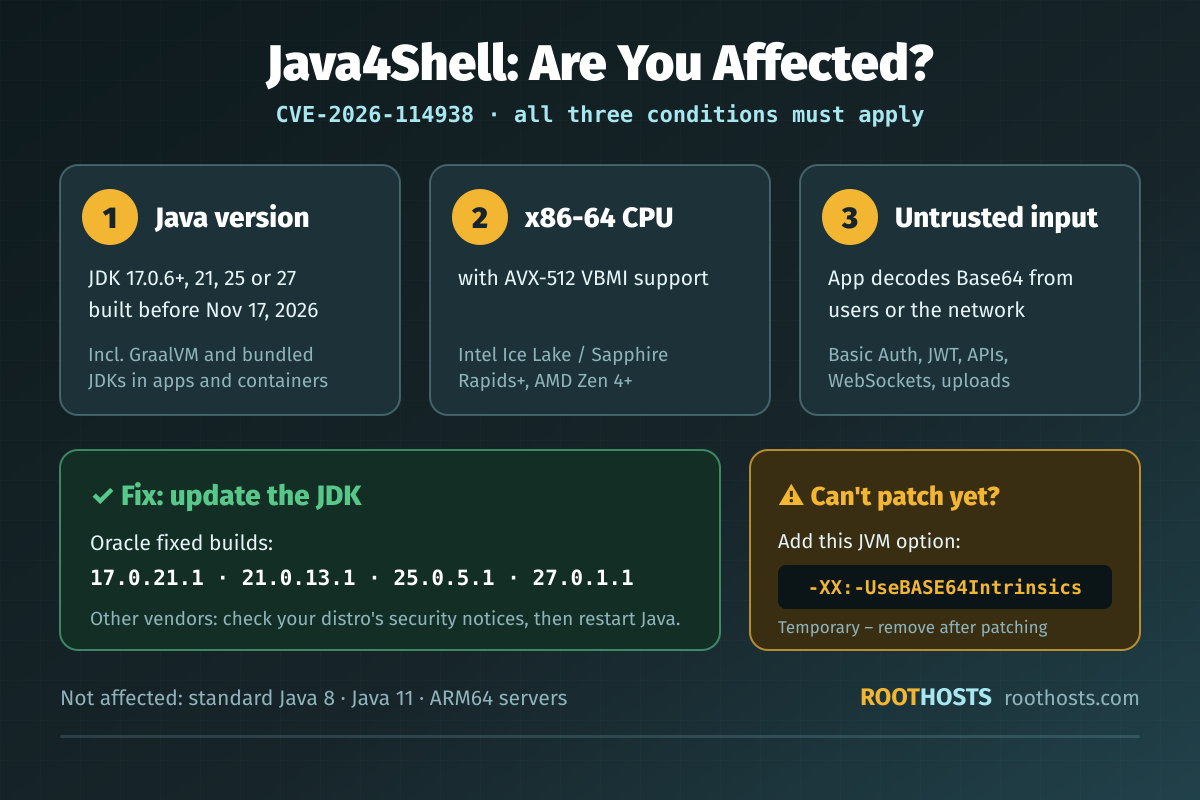
You are potentially exposed if all three of these apply:
- Java version: OpenJDK/Oracle JDK 17.0.6 or later on the 17 line, or Java 21, 25 or 27, built before the November 17, 2026 security release. Oracle GraalVM builds and the Java 8 Enterprise Performance Pack are also affected.
- CPU: an x86-64 processor with AVX-512 VBMI support, such as Intel Ice Lake, Sapphire Rapids or newer Xeons, and AMD EPYC or Ryzen with Zen 4 or newer.
- Exposure: the application decodes Base64 from untrusted input, which most web-facing Java apps do.
Not affected: standard Java 8 and Java 11, and ARM64 servers.
Older CPUs without AVX-512 are not vulnerable in practice. However, VMs and containers can be live-migrated to newer hosts, so don’t rely on that. Patch anyway.
How to check your servers
1. Find every Java runtime. Java often hides inside other software. Elasticsearch, Jenkins, Atlassian products, monitoring tools and many vendor appliances bundle their own JDK, which your package manager will not update. Check containers too: run the version check inside the running container, not on the host.
java -version
find / -type f -name java -path "*/bin/*" 2>/dev/null
2. Check whether the CPU supports the vulnerable instructions:
grep -m1 '^flags' /proc/cpuinfo | tr ' ' '\n' | grep -E '^(avx512f|avx512bw|avx512vbmi|bmi2)$'If all four flags are listed, the vulnerable code path can be active.
3. Check the JVM flags:
java -XX:+PrintFlagsFinal -version | grep -E 'UseAVX|UseBASE64Intrinsics'How to fix it
Patch first. Oracle’s fixed builds are 17.0.21.1, 21.0.13.1, 25.0.5.1 and 27.0.1.1. Other distributions, such as Eclipse Temurin, Amazon Corretto, Azul Zulu, Red Hat, Debian and Ubuntu, release fixes under their own version numbers. Watch your vendor’s security notices and update with apt, dnf or your image pipeline as soon as packages appear. Start with internet-facing systems. Then restart the Java services, because a patched JDK on disk does nothing until the JVM restarts.
If you can’t patch immediately, add this JVM option to turn off the vulnerable optimisation:
-XX:-UseBASE64IntrinsicsBase64 decoding becomes slightly slower, but the dangerous code path is gone. Remove the flag once the patched JDK is in place. CISA also recommends validating and size-limiting Base64 input at the application boundary and limiting unauthenticated access where possible.
Java 26 is a non-LTS release and will not get a fix, so move to Java 27 or an LTS version.
Watch for signs of attack
As of November 18, 2026, there are no confirmed attacks in the wild. That usually changes quickly once technical details are public. Look out for:
- unexpected JVM crashes or
hs_err_pid*.logfiles on internet-facing services - unknown Java processes or Java runtimes you didn’t install
- unusual outbound connections from Java applications
If an exposed service crashed without explanation after November 17, treat it as a possible compromise. Investigate, and rotate any secrets it held in memory, such as database passwords, API keys and session signing keys.
Need help?
Finding every hidden Java runtime across servers, containers and appliances is often the hardest part. At RootHosts, we handle Linux and Windows server security every day. We can audit your systems for Java4Shell, apply patches or temporary mitigations without unnecessary downtime, and check for signs of compromise. Our IT support comes with a 7-day fix guarantee: if the same problem comes back within 7 days, we fix it again for free.
👉 Contact RootHosts for a quick security check of your servers.